Chinese mythology is a jungle. Hundreds of creatures, dozens of sources, and names that look like someone fell asleep on a keyboard.
But you don’t need to memorize all of them. You need six. These six show up everywhere — in festivals, in art, in the names of restaurants, in the background of every Chinese fantasy film.
Here they are, in plain English.
1. The Dragon (龙, lóng)
Not the fire-breathing villain of Western stories. The Chinese dragon is a water spirit — long, serpentine, wise, and generally on humanity’s side.
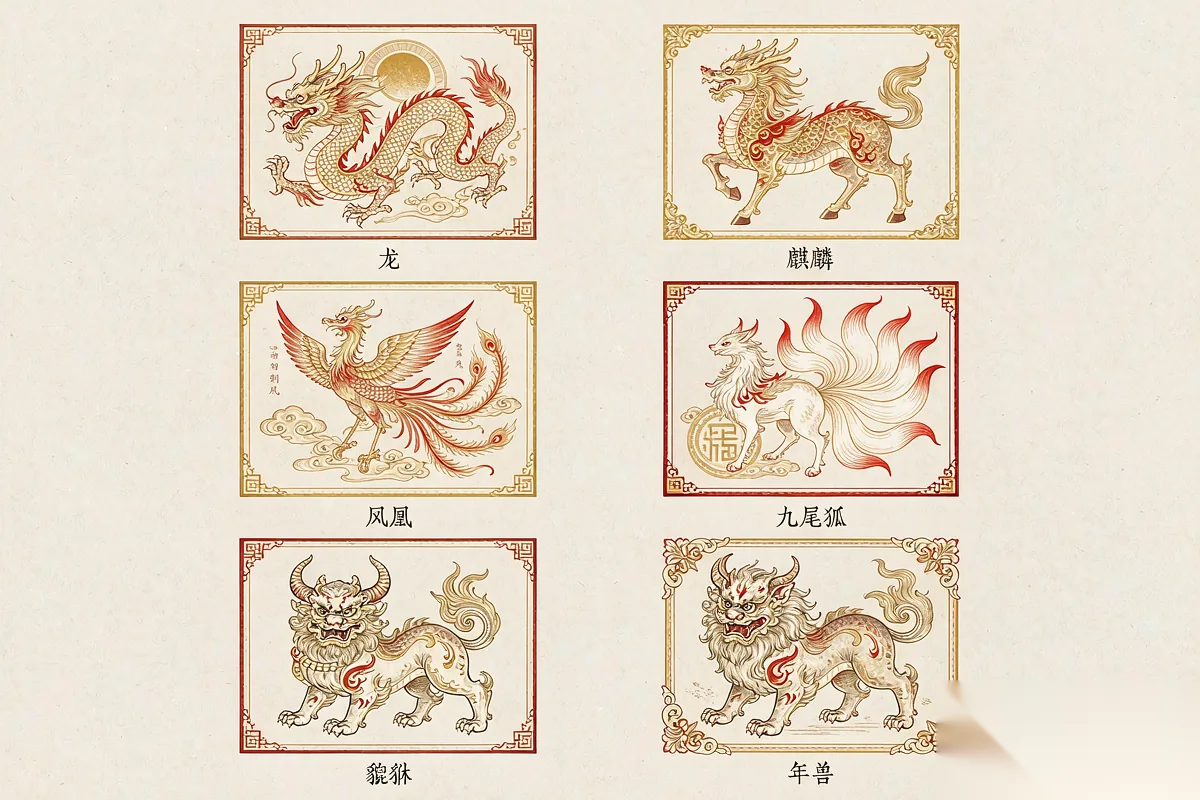
It controls rain, rivers, and the sea. It’s the symbol of the emperor. And during festivals, you’ll see teams of people carrying a dragon through the streets, making it dance.
In one line: power, luck, and rain — usually all three at once.
2. The Qilin (麒麟, qílín)
Part deer, part dragon, part unicorn, all good news.
The qilin appears only during times of peace and prosperity. Legend says it never steps on living grass and never eats a living creature. When a qilin shows up, it means a wise ruler is coming — or a great person has been born.
In one line: the good-omen creature. If you see one, things are about to go well.
3. The Phoenix (凤凰, fènghuáng)
The king of birds, often paired with the dragon. Where the dragon is male energy, the phoenix is female energy — together they represent harmony, balance, and a good marriage.
It’s also a symbol of rebirth and grace. In Chinese art, you’ll see dragon-and-phoenix pairs everywhere: on wedding decorations, on temple walls, on porcelain.
In one line: beauty, harmony, and a very good marriage.
4. The Nine-Tailed Fox (九尾狐, jiǔwěihú)
The most interesting one, honestly.
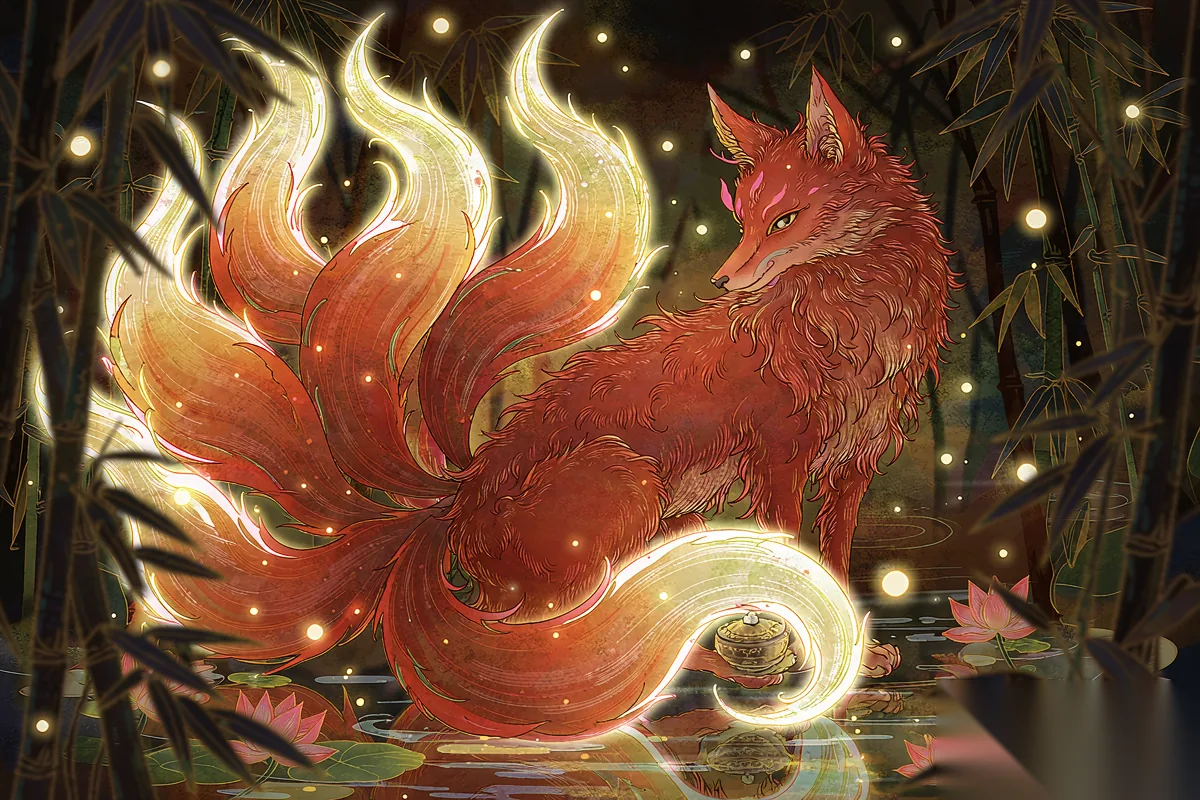
In ancient texts, the nine-tailed fox was a magical creature — sometimes a good omen, sometimes a dangerous seductress. Over centuries, its reputation shifted. In modern stories, you’ll see it as everything from a tragic heroine to a mischievous spirit.
It appears in the Classic of Mountains and Seas — one of China’s oldest books.
In one line: the trickster. Beautiful, clever, and not entirely trustworthy.
5. The Pixiu (貔貅, píxiū)
A lion-dragon hybrid with a very specific job: eating gold and never letting it out.
Legend says the pixiu has no anus — everything goes in, nothing comes out. That’s why it’s the ultimate wealth charm. You’ll see pixiu statues in shops, on desk ornaments, on bracelets.
In one line: the money magnet. Feed it gold, keep it close.
6. The Nian (年兽, niánshòu)
The beast behind Chinese New Year.
Legend says a monster called Nian came out on New Year’s Eve to eat villagers. It feared loud noises, bright lights, and the color red. So people wore red, hung red couplets, and set off firecrackers to scare it away.
Those traditions never left.
In one line: the monster that gave us red envelopes and fireworks.
How to remember them
Here’s the trick: group them by what they do.
- Nature and power: the dragon (rain), the phoenix (harmony)
- Fortune: the qilin (good omens), the pixiu (wealth)
- Story and mischief: the nine-tailed fox (trickster), the Nian (the monster)
Six creatures. Six roles. That’s enough to decode most of what you’ll see in Chinese art, festivals, and film.
Where these stories come from
Most of them trace back to the Classic of Mountains and Seas (山海经) — a 2,000-year-old book that reads like a field guide to beasts that never existed.
If you want to meet them properly — with the original descriptions, retold in plain English — our book The Classic of Mountains and Seas is the place to start.
No footnotes. No academic jargon. Just the monsters, the way they were first described.